Blockchain trial on Canton Network tests collateral reuse with tokenized US Treasurys

cointelegraphPubblicato 2025-12-09Pubblicato ultima volta 2025-12-09

Introduzione

Digital Asset and a group of major financial institutions have successfully conducted a second round of onchain US Treasury financing trials on the Canton Network. The test introduced real-time collateral reuse using tokenized US Treasurys and expanded the use of multiple stablecoins, including USDC, to enhance onchain liquidity. This innovation bypasses traditional operational delays associated with rehypothecation. Participants included Bank of America, Citadel Securities, Cumberland DRW, Virtu Financial, Société Générale, Tradeweb, Circle, Brale, and M1X Global. The Canton Network, a blockchain built for institutional finance, continues to grow in the tokenized real-world assets (RWA) space, with over $370 billion represented onchain, leading the market significantly.

Digital Asset and a group of financial institutions have completed a second round of onchain US Treasury financing on the Canton Network, introducing real-time collateral reuse and expanding the number of stablecoins involved.

Five transactions were executed in the newest phase, building on the July pilot, which first demonstrated that US Treasurys and the USDC (USDC) stablecoin could be combined to finance and settle transactions on the blockchain.

In the latest trial, the companies used multiple stablecoins to finance positions against tokenized US Treasurys, widening the pool of onchain liquidity available for financing transactions.

The trial showed that tokenized US Treasurys could be passed between counterparties and reused as collateral in real-time, sidestepping the operational delays that typically accompany rehypothecation in traditional finance.

The effort brought together Bank of America, Citadel Securities, Cumberland DRW, Virtu Financial, Société Générale, Tradeweb, Circle, Brale and M1X Global, which are all a part of the Canton Network’s Industry Working Group.

Kelly Mathieson, chief business development officer at Digital Asset — the company behind the Canton Network — said in a statement that the test was “part of a thoughtful progression toward a new market model.”

Justin Peterson, chief technology officer of Tradeweb, added that “demonstrating real-time collateral reuse and expanded stablecoin liquidity isn’t just a technical achievement — it’s a blueprint for what the future of institutional finance can look like.”

Related: ‘We refused to do an ICO’: The truth behind Canton’s tokenomics

Canton Network expands footprint in tokenized RWAs

The Canton Network, a layer-1 blockchain built for institutional finance, has been expanding its presence across the tokenization sector this year.

On Dec. 4, its developer Digital Asset secured roughly $50 million in strategic backing from BNY, iCapital, Nasdaq and S&P Global. The new funding followed a $135 million raise earlier this year and is intended to support the network’s scaling efforts.

In October, asset manager Franklin Templeton said it would migrate its Benji Investments platform — which tokenizes shares of the firm’s flagship US money market fund — to the Canton Network.

Data from RWA.xyz also shows the Canton Network now leads the market for tokenized real-world assets by a wide margin, with more than $370 billion represented onchain, far outpacing popular networks such as Ethereum, Polygon, Solana and other public chains.
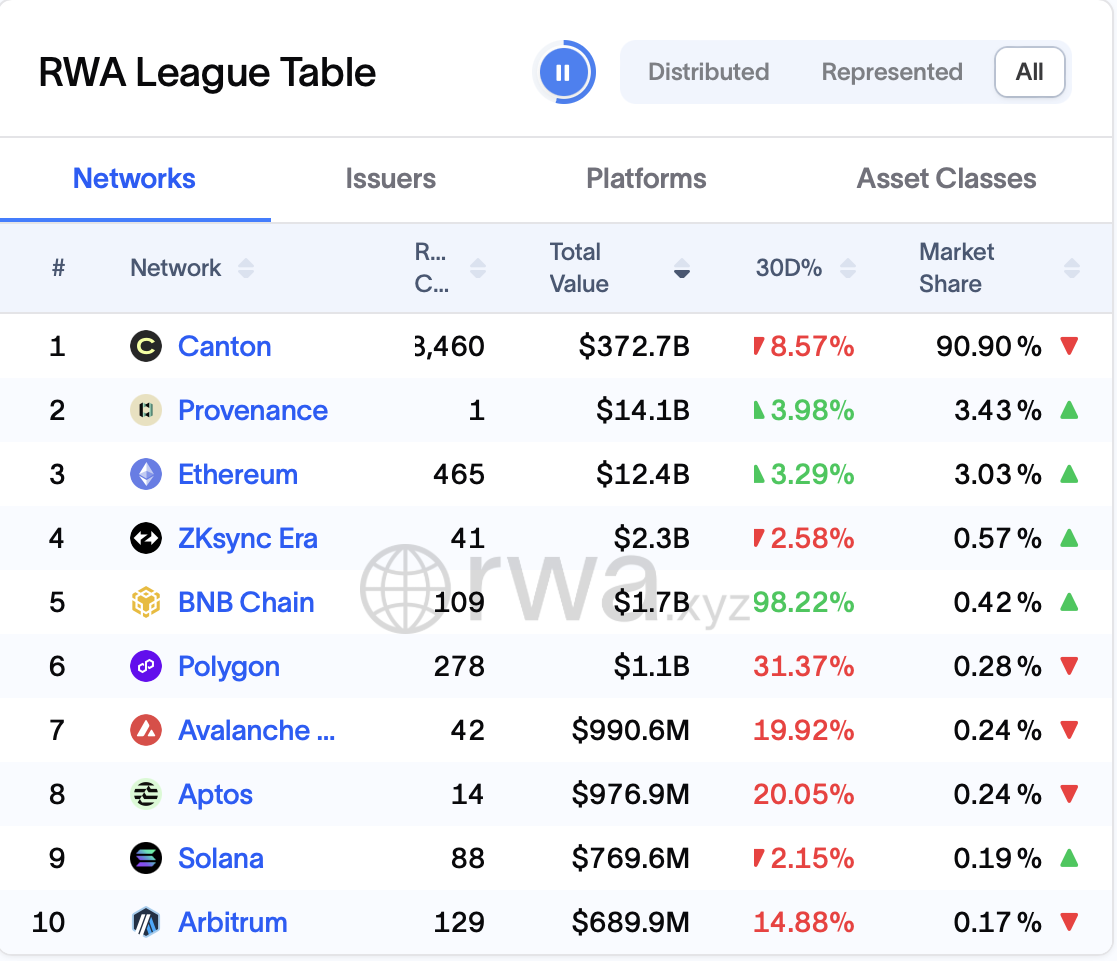
Top blockchains for RWA. Source: RWA.xyz

Magazine: 6 reasons Jack Dorsey is definitely Satoshi... and 5 reasons he’s not

Letture associate

U.S. Stablecoin Regulatory Framework Finalized, Global Crypto Finance Enters New Institutionalized Phase

The United States has enacted its first federal regulatory framework for stablecoins, marking a pivotal moment for the global cryptocurrency industry. This framework transitions stablecoins from a state of fragmented oversight to a unified federal system, establishing clear legal definitions and operational standards for dollar-pegged payment stablecoins. Key provisions mandate that stablecoin issuers must hold high-quality liquid assets—such as cash and short-term U.S. Treasury securities—as reserves. They are also required to comply with strict auditing, transparency, risk management, and consumer protection rules. The regulatory structure adopts a dual approach: larger issuers will be overseen at the federal level, while smaller ones may fall under state jurisdiction. This development is expected to significantly enhance the role of stablecoins like USDC and USDT as critical infrastructure for cross-border payments, settlements, and decentralized finance (DeFi). By providing legal certainty, the framework is likely to encourage greater adoption by traditional financial institutions, payment companies, and fintech firms, integrating stablecoins more deeply into the mainstream financial system. However, the new rules also present challenges. Higher compliance costs and operational requirements may pressure smaller issuers and could lead to industry consolidation. The shift emphasizes regulatory-driven competition over innovation-driven growth. Furthermore, global regulatory disparities remain, as jurisdictions worldwide have differing definitions and standards for stablecoins, potentially creating friction in international flows. Overall, this U.S. regulatory move signals a structural shift from an enforcement-led approach to a rules-based system for digital assets. It is seen as a maturation of the industry, setting the stage for stablecoins to evolve from crypto trading tools into foundational components of the future digital financial ecosystem, including in cross-border trade, retail payments, and financial market settlements.

cointelegraph_中文2 min fa

U.S. Stablecoin Regulatory Framework Finalized, Global Crypto Finance Enters New Institutionalized Phase

cointelegraph_中文2 min fa

Securities or Commodities? A Decade-Long Tug-of-War Ends as the 'Crypto Market Structure Act' Races to the Senate

The "Cryptocurrency Market Structure Act" (CLARITY Act) is advancing to the U.S. Senate for final review after passing the House with strong support. The bill aims to resolve the long-standing regulatory debate over whether cryptocurrencies are classified as securities or commodities. It introduces a clear framework: tokens on decentralized blockchains are defined as "digital commodities" under CFTC oversight, while those meeting the Howey test remain securities regulated by the SEC. Key provisions include a "mature blockchain" exemption for highly decentralized networks like Bitcoin and Ethereum, a 360-day temporary registration pathway for trading platforms, and a fundraising exemption of up to $75 million for certain token offerings with enhanced disclosure. The bill also establishes a joint advisory committee to improve coordination between the CFTC and SEC and explicitly exempts non-custodial DeFi actors from broker-dealer regulations. This legislative effort aligns with the Trump administration's pro-crypto stance, including the appointment of industry-friendly leaders at key agencies like the SEC and CFTC, and recent moves to allow regulated spot crypto trading on CFTC-approved exchanges. If enacted, the law would provide regulatory clarity, encourage institutional adoption, and position the U.S. as a leader in the digital asset space.

Odaily星球日报16 min fa

Securities or Commodities? A Decade-Long Tug-of-War Ends as the 'Crypto Market Structure Act' Races to the Senate

Odaily星球日报16 min fa

Trading

Spot
Futures
活动图片